
Quick answer: Simulator makers commonly treat 10 feet as ideal, about 9 feet as a practical minimum for most golfers, 8.5 feet as workable for irons or shorter golfers, and 8 feet as the absolute floor. Tall golfers and full driver swings need the most height.
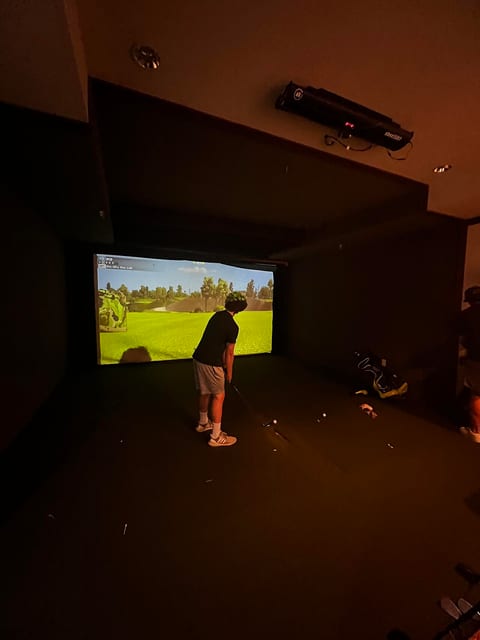
Most golf simulator planning starts with width and depth, because those are the dimensions a room can sometimes gain by moving a wall or picking a different room. Ceiling height rarely works that way. In a finished basement, a garage or an existing room, the ceiling is usually fixed, and a swing that clips a light fixture or a beam is not a problem you can wire your way around. Ceiling height also does more than cap the swing: it decides where a projector can hang without sitting in the way of the club, and that mount position decides how far the video signal has to travel from the equipment to the screen.
This guide walks through the height numbers simulator makers publish, why golfer height and club choice change the number that actually applies to you, what changes in a room under 9 feet, and how a low ceiling reaches all the way into the cable run behind the projector. None of the numbers below replace measuring your own room and testing your own swing, but they give you a realistic starting point before you commit to a space.
Golf simulator ceiling height by tier
Simulator makers do not publish one single minimum ceiling height for a golf simulator, because the honest answer depends on the golfer and the room. What they do publish, consistently, is a set of tiers that move from workable to ideal as the ceiling gets taller.
| Ceiling | Works for | Notes |
|---|---|---|
| 8 ft | Shorter golfers, irons only | Treated as an absolute floor; test before building |
| 8.5 ft | Irons or shorter golfers | Workable, not a fit for every player |
| 9 ft | Most golfers | Treated as a practical minimum |
| 10 ft or more | Tall golfers, full driver swings | Treated as ideal |
These ranges come from TruGolf and Foresight Sports, two of the launch monitor makers publishing this kind of room guidance. None of the four tiers is a guarantee. An 8 foot ceiling that works fine for one golfer playing irons can still clip the driver of a taller player, and a 9 foot ceiling that feels comfortable for most golfers can still be tight for someone well above average height. Treat the table as a starting point for planning, then confirm the number that matters with the test in the next section.
Golfer height and swing arc
The ceiling height a golf simulator actually needs comes from the top of the swing with the longest club in the bag, almost always the driver, not from how tall the golfer is standing still. A driver swing carries the clubhead well above a player's own head height at the top of the backswing, which is why two golfers of the same standing height can need noticeably different ceiling headroom depending on their swing plane and how far they carry the club through the top of the motion.
Because standing height alone does not answer the question, test the actual swing before you finalize a room. Have the golfer take a slow, controlled practice swing with a driver, without a ball, directly under the ceiling at the spot where the tee will sit. Mark the highest point the club reaches during that swing, then measure the distance from that mark up to the ceiling. Add a safety margin on top of that gap, since a practice swing rarely reaches the same height as a full swing under game conditions, and a small amount of headroom protects both the ceiling and the club.
If more than one person will use the bay, run this test for the tallest golfer who is likely to play regularly, not just the person building the room. A ceiling that clears one golfer's swing with room to spare can still be a tight fit for a taller guest or family member, and that is a far easier problem to catch with a practice swing before construction than to solve afterward.
Setting up under an 8 to 9 foot ceiling
A ceiling in the 8 to 9 foot range still supports a working golf simulator for many golfers, but it usually means adjusting what the bay is used for rather than treating it as a full-height room. Iron-only play or a shorter set of clubs is the most common adjustment, since irons carry a lower swing arc than a driver and give a low ceiling more margin to work with.
Before anyone swings a club in the room, walk the ceiling directly above the hitting area and remove or recess any light fixture that hangs down into that space. A fixture that seemed harmless when the room was empty becomes the first thing a driver swing finds once play starts. Where a fixture cannot be moved or recessed, plan the hitting area and the tee position around it instead of hoping a swing will miss it consistently.
Ceiling protection is worth adding under a low ceiling even after the light fixtures are handled, since an occasional mishit or a longer club than usual can still reach higher than expected. A padded or impact-rated ceiling panel over the swing area is cheap insurance against a single bad swing damaging drywall or anything mounted above it. Beams, ductwork and sprinkler heads deserve the same attention as light fixtures. Any of them can drop the usable ceiling height by several inches in exactly the spot above the swing, even when the room's stated ceiling height looks adequate everywhere else.
The projector itself needs to stay clear of the swing path, and a low ceiling makes that harder than it looks. Moving the mount farther back along the ceiling, away from the tee, is the simplest fix, since it puts more horizontal distance between the unit and the club at the top of the swing. Where the ceiling is too low for any mount position to clear the swing safely, a floor position for the projector removes the ceiling entirely from that particular problem, at the cost of a different set of tradeoffs covered in the projector setup guide.
One more piece of equipment has its own ceiling requirement separate from the swing itself. Overhead camera launch monitors mount above the hitting area and need enough headroom to see the ball at impact from directly overhead, so a room with a ceiling that clears the swing can still be too low for that specific type of launch monitor. Check the installation specification the launch monitor maker publishes before you assume any 8 to 9 foot ceiling will work with an overhead unit.
How ceiling height decides projector position and the cable run
A tall ceiling gives a projector mount a lot of flexibility: hang it close behind the tee, farther back toward the equipment closet, or anywhere in between, and the swing still clears it. A low ceiling removes most of that flexibility. Once the swing arc from the section above rules out the positions closest to the tee, the projector often ends up farther back along the ceiling than it would in a taller room, or moved down to a floor position entirely.
That shift matters for reasons that have nothing to do with the picture on the screen. Moving the projector changes the actual route the video cable has to travel from the sim PC and switcher in the equipment closet, and that route is rarely a straight line. The cable has to leave the closet, reach a wall, climb the wall to the ceiling, and travel across the ceiling to wherever the projector ends up, so a mount pushed farther back adds distance to a run that a floor-plan measurement will not show.
Passive HDMI cable is reliable for roughly 15 to 20 feet at 4K. A projector positioned close to the closet in a tall room can sometimes stay within that range on a straight passive cable. A projector pushed farther back along the ceiling of a low room, or moved down to a floor position on the far side of the bay, often pushes the total route past that limit once the climb up the wall and the run across the ceiling are added together.
Once the route runs longer than a passive cable can carry, an HDBaseT presentation switcher covers the distance over a single CAT cable instead of a group of separate wires. The KD-PS42 carries 4K up to 40 m with its matched receiver, and the KD-UPS52U reaches 4K up to 100 m with its own matched receiver, so a longer route caused by a low ceiling still has a straightforward path to the projector. In both cases the receiver at the projector end is powered over the same CAT cable by the switcher in the closet, so there is no separate power supply to run up the wall alongside the video cable. For the rest of the mounting and cable-run decisions once ceiling height forces a change, see the projector setup guide. The diagram below shows how the swing height and the cable route connect: a lower ceiling pushes the projector, and the route measurement, in the same direction.
Garage door tracks and openers
A garage conversion adds an obstacle that a purpose-built room never has: the garage door itself. The track the door rides on, the opener motor, and the rail connecting them typically run across the ceiling near the door, and all three can sit lower than the rest of the ceiling in that part of the room.
Measure to the lowest point along the swing path, not the highest point of the ceiling elsewhere in the garage. A garage with 9 feet of headroom in the middle of the room can still have an opener rail hanging down to 7.5 feet near the door, and that lower measurement is the one that matters if the hitting area or the swing path passes anywhere underneath it.
Where the layout allows it, the simplest fix is planning the hitting area and the tee position away from the door and its hardware entirely, using the clearer ceiling elsewhere in the garage. Where the room is too narrow to avoid the door area, consult a garage door professional about repositioning the opener or raising the track, rather than assuming the swing will clear a fixed obstacle every time. A garage conversion also tends to have a lower ceiling near the door than at the back of the bay, so measuring only once, at the spot that looks tallest, can leave the actual hitting area under a lower number than the room appears to offer.
Parts for the projector cable run
A low ceiling that pushes the projector farther from the equipment closet usually means the run needs one of these two switchers rather than a plain HDMI cable. Both include their matched receiver and power that receiver over the same CAT cable.
Signal parts for a ceiling projector
| Part | Role in the system | Note |
|---|---|---|
| KD-PS42 | Switcher in the closet, 4K to 40 m | Includes KD-X40MRx receiver |
| KD-X40MRx | Receiver at the projector for the KD-PS42 | Included with KD-PS42; powered over the cable |
| KD-UPS52U | Switcher for runs to 100 m at 4K | Includes KD-X100MRx receiver |
| KD-X100MRx | Receiver at the projector for the KD-UPS52U | Included with KD-UPS52U; powered over the cable |
Frequently asked questions
What ceiling height do you need for a golf simulator?
Simulator makers commonly treat 10 feet as ideal and about 9 feet as a practical minimum for most golfers. Taller golfers and full driver swings need the most height.
What is the minimum ceiling height for a golf simulator?
About 8 feet is usually treated as the absolute floor, and 8.5 feet as workable for irons or shorter golfers. Below 9 feet, test a full swing with your longest club before you build.
Is a 9 foot ceiling high enough for a golf simulator?
For many golfers, yes. Nine feet is a common practical minimum. Taller players and full driver swings may still need more height.
Can you have a golf simulator with an 8 foot ceiling?
Sometimes, mainly for shorter golfers or iron play. Test your swing first, protect the ceiling, and keep the projector out of the swing path.
How does ceiling height affect projector placement?
A lower ceiling leaves less room to hang a projector clear of the swing, which often moves it farther back or to a floor position. That changes the cable route from the PC, so check the run length again.
How do I measure ceiling height for a golf simulator?
Measure from the top of the hitting surface to the lowest obstruction above the swing area, such as a beam, duct, light fixture or garage door track.
Does the launch monitor need ceiling height too?
Overhead camera launch monitors mount on the ceiling and have their own height requirements. Check the maker installation specification before you finalize the room.
Related guides
Questions about golf simulator projector placement?
Send it to a Key Digital engineer. We reply within one business day.
Message sent
Thanks. A Key Digital engineer will reply to your email within one business day.